Category Archives: Interior Design

Praise and Parody for the Minimalist Home

Nature Abhors a Vacuum Cleaner, or Maybe Not

I’m always drawn to the orderly, spare, modern designs you see in glossy home magazines and books. But my house is not so spare and not everything is in its place. I’m kind of a pack rat as my wife — and office mates — will tell you. I go through periodic bouts of frenzied cleaning but the tide of newspapers, magazines, and books rises regularly. So I was pleased to come across the ingenious new book by Molly Jane Quinn and Jenna Talbott aptly titled It’s Lonely in The Modern World (Chronicle, 2011), which is an ironic primer on how to navigate the field of architectural minimalism.

These are the people who started the clever blog Unhappy Hipsters, which takes a wry look at ambitiously artful modern homes like this one and the way they’re

portrayed, where the individuals on the stoop seem quite unaware of what’s behind them (or perhaps it’s the elephant on the deck; image courtesy ifound). In these sorts of houses messy realities — like the need for windows and daylight, for example — never intrude, especially in architectural magazines. But spoofs are the sign of a publication’s success. (Remember the Tolkien parody Bored of the Rings by the Harvard Lampoon, and the one of Sunset magazine with a photo of a family picnicking in front of a nuclear reactor.) So I started looking around for ways to be both hip and realistic — i.e hide the clutter in sleek and elegant ways –  like this handsome storage bench from Herman Miller. It would help with all the bags

and blankets at the bottom of our bed. Or maybe we just need a new bed frame that incorporates storage drawers, like this version from Bluedot, which

streamlines a storage idea that was popular in the 1960s and 70s. Then what about a place for charging cameras, iphones and ipads? Bludot’s “Juice box” is

a clever solution in the way it hides the plugs and keeps the wires under control (image courtesy Mashable). This loft bedroom by Jordan Parnass Digital Architecture includes an

especially clever stair/bureau with pull-out storage drawers — though I would

probably need a railing, and I notice that the books seem to be piling up…

So in the end I confess I am impossibly conflicted because I am a huge fan of spareness and the uncluttered look and am always promoting it, while only rarely achieving it myself. Our Plan 491-2 by Braxton Werner and Paul Field

might be one answer to my dilemma — it’s uncluttered but not severe, there is storage, and pillows are scattered on the floor!

Paint Palettes New and Old

Hues and Dyes

I just played the online Color Sense Game by Voice of Color from Porter Paints (part of PPG Paints). It’s a kind of test – your answers to a range of questions like “pick 5 words that inspire you” (out of a given list), or “where would you feel most at home?”(you select one image out of a wide range), or “what animal would you be?” (again from a range of pictures) –  result in your own personal paint palette. It seemed fairly accurate in my case; that is, I liked the color range that my answers produced.

Apparently I’m “Al Fresco” – or is that the brother of Bill Fresco. Apparently it means that I like green tones. You’ll note that there is a little tab on the upper right corner that says “Your Secondary Harmony Family” (this will be news to my wife — and me too, come to think of it!).

My secondary family turns out to be the Whites…It all sounds a little corny, but I think it can help you figure out what colors are meaningful to you. Painter beware, however because if you play again and change one or two answers you may get a very different set of colors…After I switched from tiger to eagle

my secondary harmony family became Desert Spice. I think I like Al Fresco and the Whites better. I guess I’m just a cat after all.

Color is at once very simple and subjective (you instinctively like certain hues) and highly sophisticated and complex (the psychological study of color perception, for example). In the history of architecture there are many color palettes, from the vibrant reds and yellow ochres of Pompeiian frescoes (image below courtesy Natural Pigments)

to the white and intense chromium yellow that Thomas Jefferson used

in the dining room at Monticello. According to retrofit guru Bob Vila, this particularly vivid palette is a relatively recent discovery, thanks to scientific analysis of the original pigments (photo courtesy his website). At the turn of the 20th century architects like Frank Lloyd Wright and the Bay Area’s Bernard Maybeck became identified with an Arts & Crafts palette (from the movement of the same name) and evolved their own set of hues and tones

often with autumnal hues like red, burnt orange, and even gold to complement the use of natural materials like redwood and brick. In fact Wright’s favorite color was what he called Cherokee red (photo of Wright’s Zimmerman house, by David J. Bohl, courtesy Currier Museum of Art, from About.com).

European modernists like Le Corbusier developed their own palettes as well;

his was based on primary colors, but, as shown above,  included a variety of subtle variations. These colors (and the image) are from the website Aaltocolor.com. The elegant palette published in 128 Colors: A Sample Book for Architects, Conservators, and Designers, by Katrin Trautwein (Birkhauser,

Basel, 2010) includes 68 Corbusian hues along with 60 others. Trautwein founded an artisinal paint manufacturer in Uster, Switzerland in 1997. She explains how Le Corbusier’s colors were designed to “remain stable in space to support architecture’s three dimensional effects.” As a painter as well as an architect (remember his Purist efforts,

like this still life of 1922, courtesy Ferris) he knew what he was talking about. He probably was not thinking about tigers and eagles.


Fireplace Focal Points and House Plans

Architectural Warmth

Here are some images of fireplaces to help you take a breather — or just plain zone out — during the holiday shopping rush. The flames, not to mention the surround, can be mesmerizing.  The Pasadena architects Greene and Greene designed one of the most famous fireplaces  for their Gamble house of 1908.

It’s an inglenook in the living room — rather like a very elegant compartment on a train that just happens to have a large fireplace between the bench seats where the window would be (photo courtesy The Gamble House). Frank Lloyd Wright was famous for his fireplaces and an almost ritualistic attitude toward the hearth as the very center and soul of a home.

At Fallingwater in Pennsylvania, of 1937,  he created an organic inglenook from boulders on site (photo courtesy About.com). In the late 1940s, ranch house popularizer Cliff May took the fireplace

outside and added a rotisserie/barbecue. The architectural possibilities are vast and have grown substantially with today’s prefab gas units, like these examples from Ortal Heating Solutions. One can extend across an entire wall

or become a minimalist room divider

that doubles as a display space for artifacts. A frameless glass front can turn the

corner in a minimalist modern way (these three photos courtesy Ortal).

So how do the architects and designers at Houseplans.com treat the fireplace? For Sarah Susanka in Plan 454-6, the fireplace becomes part of a multifunctional wall

with space for storage and display as well as a flat screen television. In Plan 491-7 Braxton

Werner and Paul Field treat it more abstractly as part of a stone wall. Lorenzo Spano echoes Cliff May by going outside with it in Plan 473-3,

only now making it a freestanding piece of sculpture. There are many ways to spark your architectural imagination.

Barn House, Backsplash, and a Cool Thermostat

 A Rustic Space-Time Continuum

For many homeowners – with apologies to Star Trekkers – it’s really interior space that’s the final frontier. The potential for improvement is infinite. Take this new house by innovative and edgy interior designer Erin Martin working with an adventurous Napa Valley client. It’s both rustic — as a barn-inspired ranch house — and highly refined.

The big timber structure, which supports a sleeping loft over the kitchen, is exposed and becomes a foil for a sophisticated black and white furniture palette. The loft itself is simple but eye-catching, and not a little galactic,

thanks to an art piece suspended on a rope and resembling a dusty comet — or a hay bale on a bad hair day. It’s wonderful, like a tiny hint of Halloween. The table on the dining porch reads as a vertical extension of the floor, thanks to

the continuity of material — the same kind of boards are used for both. It’s a clever idea and makes you wonder just for a moment which is which — porch or table — rather like an Escher print. Martin’s design of the galley kitchen is particularly effective at enlivening our perception of space through the use of contrast. Her backsplash, for example, does more than protect the wall above the sink from water damage — not to mention the occasional “wormhole.”  She used antiqued mirror to cover the wall behind the range.

The soft indistinct reflection adds surprise while visually expanding the space into a sort of parallel universe. In this view straight down the galley


see how the backsplash almost blends with the windows, adding a little reflective mystery to contrasts with the bunkhouse-like floorboards. The peninsula dividing the kitchen from the dining/living area


includes an integral sink that simplifies the line of the counter, further blurring boundaries.

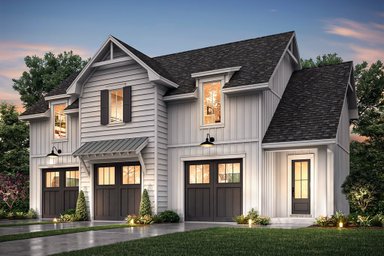
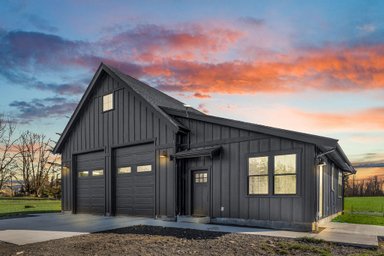
The barn has always been a good starting point for home design: a typical barn layout — which is similar to that of the Roman basilica — includes a high central portion and lower side aisles. One of our newest exclusive designs, Plan 530-2 below,

by Classic Colonial Homes, makes use of this arrangement for the garage; the living space is in the loft. Architect David Wright‘s Plan 452-1

glazes part of the roof to brighten the rear porch and the adjacent living room. Architect Francois Levy took took inspiration from gambrel-roof barns for his Plan 450-2.

Here the garage door is deceiving — it’s used not for a garage but as a way to open up an entire wall of the living space. Barns are always worth a look, if not a double take.

Heat Seeker

Finally, just in time for colder weather, a thermostat that turns up the heat through modern functional design: it’s the new Learning Thermostat from Nest, a company founded by Tony Fadell, formerly of Apple — so naturally it’s a sleekly appealing object in its own right. It’s also intuitive — just turn the dial the way you did with units of old but now there’s a new twist, not to mention a learning curve.

According to Tony: “Turns out you change the temperature in your house 1500 times a year. 1500! Our thermostat learns what temperatures you like so it can program itself. It senses when you’re out and turns itself down. And we started from scratch with design, so it’s beautiful.” I concur, though it reminds me a little of the lyric from Santa Claus is Coming to Town:  “He knows when you’ve been bad or good, so be good for goodness sake…” It has fully integrated software,  provides energy-saving tips, can be controlled from your smartphone, and installation is over most existing circuitry. If you’re good maybe you’ll get one!


Man Caves and Other Magnets

Attractive Nuisance — or Not

Every home should have a place to relax on your own or with family or friends. For some this retreat is claimed by one gender and is often called a “man cave,” and is stocked with potables, munchables, and viewables. A current television ad for IKEA includes a minimalist modern example and the Sydney IKEA store even has one on the premises, which is cleverly described in The Week as “Manland: Day Care for Husbands.” Here’s an image of it, courtesy of Core77: amenities include magazines, free hot dogs, a pinball machine, and a Fussball table in a bright minimalist design environment. A more typical non-IKEA example might be a room where sport decor dominates, like this one.

I like the helmet wall but wonder about the barber  chair — for clipping penalties, perhaps? (image courtesy The Loss Column, Baltimore Sports). Some of the designs at Houseplans.com have rec rooms that could easily “evolve” with the addition of a wet bar,

like the sculptural modern one built into Plan 56-610, shown above.

Try googling “man cave” and you’ll find an entire industry devoted to this subject, with retreats that include everything from vintage jukeboxes and the odd firing range (“Don’t mind those muffled explosions — that’s just Borromir downstairs in the armory.”) to complete woodworking shops – as illustrated by writer Jennifer Matlack’s article on a handsome eco-savvy garage (shown below, courtesy Sunset Magazine.)


The entertainment here, aside from the vintage Mercedes roadster, is the workshop.

Designed by Harrison Architects, an imaginative Seattle firm, the garage includes a drought-tolerant sod roof planted with sedums and grasses, recycled newspaper insulation, and translucent polycarbonate wall panels — so it’s a retreat with a conscience.

Ergo, the man cave is not just about a basement, a keg of beer, and a behemoth flat screen anymore! Personally, I’d go for a more multi-purpose room – and I’d like to stay married — but I am intrigued by the range of invention displayed by these spaces.

Perhaps the ultimate man cave is on the island of Brac on the Dalmatian Coast. I visited it last week (in my constant search for bloggable items, of course). A relic from World War II, it’s a disused submarine pen or hideout.

Accessible only by boat, of course, it’s pretty basic — and only room for one sub.


But there’s space for essential supplies. According to our guide this where the local male population comes to chill out: I saw plenty of chairs and ice chests on the ledge…

No need to watch old war movies here…because you’re in one! You could say, as a brother just reminded me, that the “Hunt for Red October” is over.