EYE ON DESIGN BY DAN GREGORY

Entries categorized as ‘Design Ideas and Inspiration’

Micro Cottages

November 5, 2009 · 2 Comments

Thinking Big By Starting Small

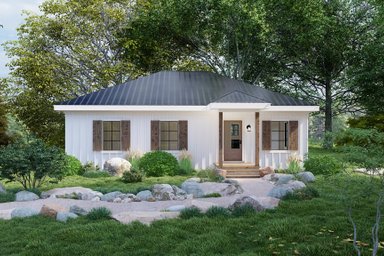
I met up with a developer friend at the Urban Land Institute’s Fall Meeting and Expo in San Francisco this week (more about this event in a later post), and he said he was looking for what he called “Micro Cottages.” It made me think about plans that might start small and grow over time when circumstances and budgets allow — which seems a practical approach to home building in the current economy. So of course I looked through our inventory and created a collection of plans that are 1,000 square feet and under. For example, Plan 466-1

466-1e-400

shown here, is 400 square feet

466-1mf-400

and is basically just one and a half rooms: a studio with a kitchen alcove and an enclosed bathroom. The front covered patio is an outdoor room for use in good weather. I can see adding onto this plan in various ways, such as turning the patio into an entry hall with added bedrooms and bathrooms opening off it.

Or take one of Bill Turnbull’s Sea Ranch Cottages (mentioned in an earlier posting), like Plan 447-1,

447-1e-650 cottage photo

somewhat grander at 650 square feet. Again, the porch is an important expander in good weather.

447-1mf-650second image

A simple way to enlarge this plan would be to add more bedrooms and bathrooms off the living room and turn part of the front porch into a glazed hallway leading to them. Then the main living space could take over the original sleeping area.

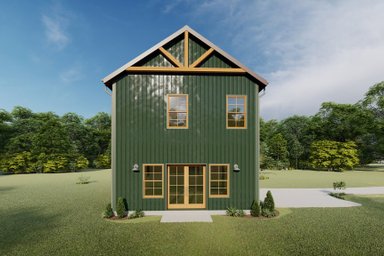
Plan 471-1, below, is a 500 square-foot  module.

471-1e-500

Designers Sarah Ascolese and Misty Weaver designed it to be a kind of multiplier.

471-1mf-500

Add up (literally!) — to 1,000 square feet — and you have two stacked modules, like Plan 471-3:

471-3e-1000

with sleeping area now on the second floor. Or expand to the side as in Plan 471-2

471-2mf-1000

and you have 1,000 square feet in a horizontal configuration. The space between could be glazed to become an entrance hall. For more “Start Small” home ideas see our Micro Cottage Collection. Each could grow up to be a larger home someday.


Categories: Architectural Innovation · Design Ideas and Inspiration · House plans, layouts · Modern Houses · Regional design · contemporary home design

Modern Living At Bat

October 22, 2009 · Leave a Comment

Hitting Home

The approaching World Series makes me think about connections between baseball and contemporary home design. Themed decor is an obvious overlap and a brief web search produces a wide array of examples. This novel wall clock by Pachi Paradice from Squidoo

draft_lens5749392module44560712photo_1247729834Sports_Clock_-_Baseball

uses baseballs for numbers, suggesting new ways of telling time, like “quarter-after first base” (4:15) or “half-past home” (6:30). I think the  hands should be centered on the pitcher’s mound, however, not second base, because time and the game really begin with every pitch. Baseball wall murals

baseball_fl_top mural from wallpapers, murals, blinds, and more!

like this 9- by 15-foot example from Classic Wallcoverings, Inc., might suit a media or family room. (Bring out the garlic fries!) Or what about a baseball bat lamp

baseball bat lamp from rerun productions

made out of a recycled metal slugger from Rerun Productions. It’s an odd idea but the tapered shape seems to work rather well. And naturally every front doormat

FireShot capture #252 - 'HOME PLATE MAT I Home Plate Mat Welcomes Baseball Fans at Your Door I UncommonGoods' - www_uncommongoods_com_item_item_jsp_itemId=15042

is really home base. The one shown above is from Uncommon Goods.

Interestingly, the baseball diamond makes a useful house plan diagram. For example, if I rotate Plan 48-415 slightly,

48-415mf-1891 mascord plan

home base becomes the front entry; first base: bedroom 2; second: the master suite; and third: the kitchen. The dining area makes a good shortstop — for a short stack? — and the great room is a natural infield. Of course the back yard becomes the outfield and maybe the garage is the dugout. (You can’t do this with football.) The point is that a simple way of organizing a home is to think of it as a malleable baseball diamond. The tricky part is adjusting the space between the major rooms, er bases. You can borrow space but there’s no stealing.

Teamwork

Baseball has other connections to home design. My wife and I were in Buenos Aires earlier this year, visiting our daughter on her semester abroad. She had a room in the elegant early 20th century house of a remarkable woman named Diana who had raised three children there after her husband suddenly died. A plant-filled front hall, high ceilings — some a little crumbly and patched but full of character and style — welcoming dining and living rooms, and a roof deck were key features. Diana spoke very movingly of the house as “my partner in raising the children.” The roof deck was especially important as a protected place for them to play in that particularly dense section of the city. In other words, like a dependable catcher, a good house is a team player, working with you as life throws new challenges, allowing you to live not just more comfortably, but more fully.

Outfields of Dreams

The roof deck-as-team-player is worth considering for houses on tight lots with little yard space. The deck can be at the top of the house

431-8alt2-2386 for roof deck

as in Gregory La Vardera’s Cube House, Plan 431-8, or to one side

472-7e-1905 for roofdeck

shown here over the carport in Plan 472-7, or

64-195e-2592

above a detached garage as Plan 64-195 shows. In all of these cases you just have to be sure your decking is over a gently sloped, well drained, and permanently sealed (often with an elastomeric membrane) roof.

Another way to to make sure your chosen plan is a team player is to customize it by building in a little flexibility; for example, by making sure there’s a ground floor bedroom and bath for when stairs become a problem. A good house plan can accommodate the seventh inning stretch.

Categories: Architectural Innovation · Architectural Styles · Decorating Ideas · Design Ideas and Inspiration · House plans, layouts · Recycled products · contemporary home design · modern houses and house plans
Tagged: , , , , ,

Once and Future Home Ideas

October 8, 2009 · Leave a Comment

Drawing from Disney

Walt Disney was fascinated with the shaping of space both visually and physically, from the way he transformed the animated film to his invention of the modern theme park. I think architecture was always an important theme for him, like the shiny-bright suburb in the Goofy cartoon Motor Mania of 1950 or the suave contemporary ranch house in the original Parent Trap of 1961. I vividly remember touring Monsanto’s  House of the Future at Disneyland

futurehouse_bluesky

(image fromYesterland.com) with its curvilinear white plastic pods

monsanto04 section, dailyicon.net

cantilevered over a central support and utility podium (Yesterland.com). Though designed not by Disney but by two MIT professors — who must have been channeling Buckminster Fuller

Dymaxion House model from website

and his similarly central-masted Minimum Dymaxion house of 1929 — Walt had the sense to give the plastic Monsanto house a ten-year lease in Tomorrowland. The swoopy modern  furniture from fifty years ago

monsanto05 lv rm dailyicon.net

still looks contemporary today (Yesterland.com photo)

I was reminded of these images and Disney’s huge influence on design and our appreciation of it when I toured the superb new Walt Disney Family Museum in San Francisco’s Presidio, which opened last week. Two hours flew by. I felt I had stumbled into an animated autobiography, or rather, a compelling four-dimensional biopic.

San Francisco’s Page & Turnbull Architects have deftly inserted the state-of-the-art museum

WDFM by Cesar Rubio

into an historic 19th century brick row (photo by Cesar Rubio) along the Presidio’s parade ground — which is itself like a distant extension of Disneyland’s own Main Street. From the front there’s no hint of the wonderland within. And at the rear only an elegant glass skin

Disney Museum

drawn across an addition (photo by Bruce Damonte) suggests a house of marvels. You experience the museum as a journey through Walt’s life with text blocks, still images, film clips, memorabilia, and narrations by Walt and others every few feet along a carefully choreographed and roughly chronological path. It’s a soft cacophony of sounds and images,  a “dark ride” that you walk, and even then it’s impossible to absorb everything.

Highlights for me are the multi-story “multiplane camera” that allowed Disney  filmmakers to create a realistic sense of depth within animations, the clever elevator that’s designed as a train car (the vertical naturally becomes the horizontal in this Looking Glass world), and the sleek modern terrazzo-and-glass mini-Guggenheim ramp

dol_dfm_v10__0042_MUSEUM-_-museum-campus_disneyland gallery

(image courtesy Walt Disney Family Museum) spiraling around a huge and meticulously detailed scale model of Disneyland.

In one sense it’s all a bit deifying, as if Walt were a latter day King Tut, but — as they say in Egypt — what a cool tomb! And here the hieroglyphics even dance to Silly Symphonies.

Beyond the Casino

I was also in Las Vegas last week, for a talk about Cliff May’s ranch houses at the World Market Center, which is another sort of  “ride.”

WMCLV_aerial

Well off the Strip on the north end of town across from City Hall (you can see the Stratosphere Casino tower in the background), this enormous furnishings marketplace is a contemporary landmark in its own right. The complex consists of a series of interpenetrating cubes and polygons that wrap around a 15 story tall central court that’s open to the sky,

West Coast Green  and Las Vegas 025

like a box canyon from Red Rocks Park  reassembled as a building. It feels like the entrance to Oz. One of the great things about this design center is that it’s open to the general public, not just to professional designers. The Center’s Design Salon

shopping1

offers consumers the ability to purchase designer furnishings previously offered only to the trade. Complimentary one-hour consultations with interior designers accredited by the American Society of Interior Designers are also offered. It’s a good place to get ideas for shaping or reshaping your home.

A short ride away is the new 180 acre Springs Preserve, Las Vegas’ answer to Tucson’s Living Desert Museum, and built on the site of the original springs for which the city is named (vega means spring in Spanish).

West Coast Green  and Las Vegas 047

Here’s one of  the rotundas, recalling a sculptural sundial or open cistern. Part of the vast indoor-outdoor complex comprises a  sustainability hall where one gallery has  been turned into a model home — which puts a novel recycling spin on that overworked trademark phrase “what’s done in Vegas stays in Vegas.” One of the most effective exhibits here

West Coast Green  and Las Vegas 043

West Coast Green  and Las Vegas 044

simply shows how much water is used in a typical five-minute shower with and without a low flow showerhead. (Nothing about sand baths, however…) Elsewhere in the museum you can experience a simulated desert flash flood (perhaps the other side of sustainability?) which in this case is fun: inside one of the buildings you stand on a metal bridge across a boulder-strewn arroyo and suddenly the water surges around and under you.

So what does it signify, when Disney comes to San Francisco and resource conservation arrives in Las Vegas? That may sound like the resolution of some distant prophecy but I think it means that things are looking up.

In other news, check out Writer Tracey Taylor’s  fine article about about us and affordable home design in the Financial Times! Her website tktaylor.com includes a wide range of stories about design and is a must read.

Categories: Architectural Innovation · Architectural Styles · Decorating Ideas · Design Ideas and Inspiration · Furniture · Green Design · Kitchen and Bath · Modern Houses · Uncategorized
Tagged: , , ,

Back to School: Modern Architects on Film

September 25, 2009 · 1 Comment

Lights, Camera, Buildings!

You can learn a lot about how great architects shape space from the range of design documentaries now available.  For example, Checkerboard Films has just released Ray Kappe, California Modern Master: 40 Years of Modular Evolution, which explores the career of one of America’s most innovative and influential architects.

kappe film cover

From the cover alone you get the sense that this designer is interested not just in thinking but leaping outside the box. See how roof planes, floor planes, and wall planes extend outward and upward as if reaching to infinity.  Stretching the mind is definitely part of Kappe’s approach — he was the founder of SCI-ARC (the Southern California Institute of Architecture), which has taught generations of talented architects  –  many of whom I covered for Sunset. Ray went to U. C. Berkeley and worked briefly for the Bay Area firm of Anshen & Allen, designers of many mid-century modern houses for developer Joe Eichler, before settling in Los Angeles.

The film explores in depth (or height!) the house he designed for his wife Shelly and their family in 1967: a series of seven interpenetrating trays suspended over a steep upslope. It’s wonderful to experience the house cinematically because, to my mind anyway, that’s how it was designed: as a kind of three dimensional film strip.

KAPPE HOME EXTERIOR small from Kappe + DU

The warm wood-and-glass framed levels are supported on four 8- by 12-foot concrete, skylit towers that form the bathrooms and the kitchen. Cantilevers allowed him to get an expansive, multi-layered house on a very tight site. In the film Ray mentions his interest in the work of Paul Rudolph — whose Art & Architecture Building at Yale is a sculptural extravaganza of interpenetrating layers — and you can see Rudolph’s almost Baroque spatial sensibility resonating throughout Kappe’s design.

When Ray and Shelly kindly gave me a tour some years ago I marveled at how everything overlapped. Here’s an image of the living room,

Kappe_LR_09_09_09 from Ron kappe site

(both photos courtesy of Kappe+ DU Architects) showing how the space overlooks a study and is in turn overlooked by the bedroom level. I asked Shelly how they brought up children in such an open interior where railings are either glass or just not there, and she said: “Oh they simply learned where the edges were.” There are no handrails in the stairway either, which, as Ray explains in the film, is a way to make people more aware of what they’re seeing. I might call it the power of the double take…or just plain fear of flying. Also the Kappe children always helped hand the groceries up. Living in the house must have had an effect: their son Ron Kappe is a distinguished architect in his own right.

Ray Kappe’s recent modular, LEED platinum-rated “Living Home” for prefab entrepreneur Steve Glenn is also shown in the film. The Checkerboard series includes documentaries on Yoshio Taniguchi (designer of New York’s Museum of Modern Art),  Philip Johnson, Sir John Soane and others.

Other design films for your Netflicks cue should include the following two. Infinite Space: The Architecture of John Lautner,

poster for John Lautner film Infinite Space

presents the work of another towering LA innovator. Lautner used concrete and glass in radically sculptural ways and his houses — no two alike — often became stage sets for Holywood movies, especially James Bond films. I met Lautner long ago when I was writing about one of his houses and he told me: “When you design a house you’ve not only got to design the house, you’ve got to design the site, and you’ve got to design the client.” Now that’s a custom house!

The other must-see is My Architect: A Son’s Journey,

homeimage1 My architect Kahn film

the extremely moving exploration of Louis Kahn’s career and life by his son Nathaniel Kahn.  The Salk Institute in La Jolla, California is perhaps his most famous building, but he also worked outside the US. I saw this film with my recent college graduate daughter. At the end, when a man tells Nathaniel that Kahn’s Parliament Building in Dhaka, Bangladesh “gave us democracy,”  I couldn’t help dissolving into tears. My daughter recoiled at my emotional response: “Get a grip, Dad!” Well, what can I say? Good design can be affecting on the big screen.

Categories: Architectural Innovation · Architectural Styles · Design Ideas and Inspiration · Eichler plans · Green Design · Modern Houses · Uncategorized
Tagged: , , , , , , , , ,

Water in the Landscape

September 2, 2009 · 2 Comments

Wall Fountains and Water Tables

Water is always a compelling visual and aural feature in a landscape. When a small garden needs a focal point, consider the wall fountain. It can mask street noise or draw the eye and is especially useful as a way to lend character to narrow side yards.  Prefabricated examples abound, like this X3 trough unit from Garden Fountains

cm-FT-125-375 X3 fountain

or the slim Echo fountain shown below, also from Garden Fountains.

cm-FT-119-375 echo fountain from gardenfountain

This contemporary example from W Studio, below, bends a wall-like water feature into a piece of sculpture.

copper1 water studio

If there is more space or an existing pool, a built-in wall fountain can add a dramatic effect. Dallas landscape architect David Rolston specializes in the design of gardens with water features as focal points. Several of his projects show how inventive the simple wall fountain can be.

Closeup_of_fountain_wall_portfolio_spillway by Davild Ralston

The small spillway in the low wall turns an entire swimming pool into a fountain.

Rolston_water_wall_SMALL_portfolio_detail fishpond by david ralston

Or here’s a more rustic feature spilling into a small fishpond from a masonry wall.

Spa_chute_portfolio_detail david rolston

This playful chute makes me want to float toy boats down it.

If a more contemplative feel is what you want, a reflecting pool might work — for moonrises and cloudscapes. Here’s a London roof deck that uses the simplest palette of materials — a raised sheet of water, decking, horizontal wood fence, grasses, and a brick chimney — to create a serene outdoor room.

London roof terrace by Jinny Blom

The pool is literally a water — er coffee — table as reflecting pool. The design and the photograph are by Jinny Blom. In a way it’s a descendant of the original water table idea from the Renaissance,

Villa Lante cardinal's water table by leogiordani

like the one at the Villa Lante near Viterbo in Italy, built for a cardinal, as part of a grand terraced water garden (photographed by leogiordani).  It’s more table than pool; the cardinal liked to cool his wine bottles in the trough at the center (still a good idea!) and the small stream ran through the table and down to the next terrace.

Something a little jazzier, perhaps, with overtones of ancient rituals via Las Vegas, not Rome,

matt basalt fire reflecting pool by archt Korn randolph, water studio

is the fire and water reflecting pool made of basalt by architect Korn Randolph from Water Studio for a Hollywood residence.

Nature and Nurture

Since we’re speaking of water in the landscape, I have to mention a particularly wonderful public example that I just revisited in Portland, Oregon while attending a family wedding. It’s the largest wall fountain around, on par with the Trevi in Rome.

Portland fountain and wedding 009

The Ira Keller Forecourt Fountain was designed by landscape architect Lawrence Halprin in 1970. Halprin’s work includes the Roosevelt Memorial in Washington, D. C., Freeway Park in Seattle,  and the master plan for Sea Ranch.

Portland fountain and wedding 007

The fountain impressed me anew with its power as an interactive  art piece.  The park covers a small sloping city block. At the top, water streams out of the earth in widening channels that stair-step down to deep polygonal pools before roaring over chiseled 30-foot-high concrete cliffs and into the swirl below.  In the roiling pool at the base of the escarpment overlapping concrete platforms appear to float above the water. It’s like a flooding stone quarry — abstract and “super” natural at the same time.

Portland fountain and wedding 012

Larry’s wife is the dancer and choreographer Anna Halprin and you can see her influence: the fountain is an irresistible stage play: call it “Total Immersion In Nature.” When I was there several children and at least one adult waded into and around every part of it, galvanized by such a thundering castle of confluence. It  made me think about how the water and the structure work on each each other to create something different, new, and compelling. This is the power of landscape on a public scale. And while most private landscapes can’t include such grand gestures, the best residential gardens help us find refreshment in the natural world in much the same way.

Categories: Design Ideas and Inspiration · Home Products · Landscape Ideas · Uncategorized
Tagged: , , , , , ,